Farm Digesters by Jonathan Letcher
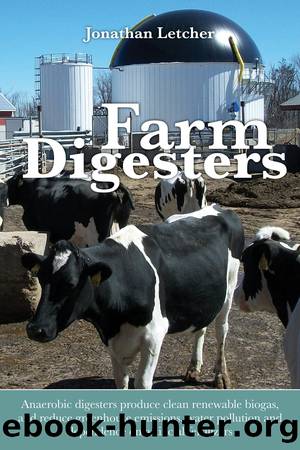
Author:Jonathan Letcher
Language: eng
Format: epub
ISBN: 9780857842374
Publisher: UIT Cambridge Ltd.
Conclusion
Producing renewable energy is a fundamental part of the digester process. For the individual farm, energy production will always play a key role in the economics of a digester. It can also help to stabilize a farmâs economy as a whole, by creating a steady income that is not dependent on the price of food. On a national scale, biogas production can help to create a cleaner, more sustainable alternative to fossil fuels. It can also increase our energy security by helping to decentralize production and to create a network of varied energy sources based on local resources. Worldwide, producing clean renewable biogas in place of fossil fuels has other important benefits. It can help to provide an alternative to the destruction of whole landscapes by opencast coal-mining operations in countries such as the USA and Australia. In China, and in many developing countries in Asia, Africa and South America, as we will see in a later chapter, the energy from small domestic digesters is transforming the lives of millions of the worldâs poorest people, as well as substantially reducing greenhouse gas emissions. But it is essential to remember that energy production, as far as digesters are concerned, is only one part of the picture. As we saw in the first chapter, the wider environmental, waste-recycling benefits of farm digesters were recognized in Denmark as long ago as 2000.
Although renewable energy production is important, farm digesters are first and foremost a multifaceted waste management facility. In this respect they are completely different from other sources of renewable energy, such as wind turbines. Wind which is not harnessed to produce power from a turbine has no effect on greenhouse gas emissions, one way or another. But raw livestock waste which is not treated in a digester is constantly adding to global warming, through methane and other emissions, like a leaking tap. These emissions are being given off at present, to some extent, by every livestock farm which does not have a digester.
Industry sources suggest that our current incentive scheme for generating renewable electricity from biogas may lead to the building of 100 very large new digesters in Britain over the next 12 months. This will be a substantial increase in our stock of installations. But most of these plants will almost certainly be processing mainly if not entirely maize silage or other energy crops. So while they will help to replace some fossil fuel with a cleaner alternative, they will have little or no impact on the main source of agricultureâs greenhouse gas emissions â the methane given off by livestock waste. There are about 100,000 livestock farms in Britain. The vast majority are far too small to generate electricity profitably under the present scheme. The Renewable Heat Initiative also seems unlikely, on its own, to lead to more than a modest number of installations in the near future. If we are going to reduce the emissions from agriculture effectively, we must find a way of helping as many farms as possible to have access to a digester.
Download
This site does not store any files on its server. We only index and link to content provided by other sites. Please contact the content providers to delete copyright contents if any and email us, we'll remove relevant links or contents immediately.
Whiskies Galore by Ian Buxton(42140)
Introduction to Aircraft Design (Cambridge Aerospace Series) by John P. Fielding(33233)
Rewire Your Anxious Brain by Catherine M. Pittman(18780)
Craft Beer for the Homebrewer by Michael Agnew(18330)
Cat's cradle by Kurt Vonnegut(15525)
Sapiens: A Brief History of Humankind by Yuval Noah Harari(14536)
Leonardo da Vinci by Walter Isaacson(13471)
The Tidewater Tales by John Barth(12744)
Thinking, Fast and Slow by Kahneman Daniel(12502)
Underground: A Human History of the Worlds Beneath Our Feet by Will Hunt(12217)
The Radium Girls by Kate Moore(12165)
The Art of Thinking Clearly by Rolf Dobelli(10689)
Mindhunter: Inside the FBI's Elite Serial Crime Unit by John E. Douglas & Mark Olshaker(9495)
A Journey Through Charms and Defence Against the Dark Arts (Harry Potter: A Journey Throughâ¦) by Pottermore Publishing(9333)
Tools of Titans by Timothy Ferriss(8569)
Wonder by R. J. Palacio(8218)
Turbulence by E. J. Noyes(8183)
Change Your Questions, Change Your Life by Marilee Adams(7914)
Nudge - Improving Decisions about Health, Wealth, and Happiness by Thaler Sunstein(7836)
